T20 predictions built on 38,400+ matches
Our prediction engine crunches historical T20 data to suggest captain, differential captain, and safe captain for every fixture.
When to override predictions
The T20Sports Fantasy prediction engine combines three data sources: historical matchup data (38,400+ T20 matches in our database), venue profiles (for 92 international T20 venues), and recent player form (last 10 innings weighted by competition level). The output is a probabilistic captain suggestion for every player in every fixture. Each suggestion includes three profiles - top consensus (highest expected points), differential (low selection% + high ceiling), and safe (low variance + good floor).
When to trust predictions: 60+ minutes before match start, before team sheets are released. The engine has full visibility into historical matchups, venue profiles, and recent form - all the data points it needs. Confidence is highest when all three signals agree (good matchup + favorable venue + good recent form). Confidence drops when signals conflict (good matchup but poor venue, or good recent form but weak matchup). In those cases, defer to your own read.
When to override predictions: after the team sheet is released, predictions lose some relevance because specific player combinations matter. If two openers are listed and the venue heavily favors the new ball, the captain pick shifts toward the opener who plays more dot balls early - the engine weights this but cannot know every bowler rotation. After toss, dew factor can shift captain priority: in heavy-dew second innings, spinners get harder to grip, so batting captaincy in the chase becomes more valuable than bowling captaincy in the defense.
The engine does not pick for you - it presents three profiles and you pick. The 2x multiplier on captain and 1.5x on vice-captain amplify the difference between profiles. For mega contests with thousands of entries, the differential captain profile wins often enough to be worth the additional risk. For head-to-head contests where you want to protect your floor, the safe captain profile is the right call. For practice contests where you are testing a thesis, the top consensus captain profile lets you focus on building team structure.
RR vs GT — 9 May 2026 fixture preview + fantasy call
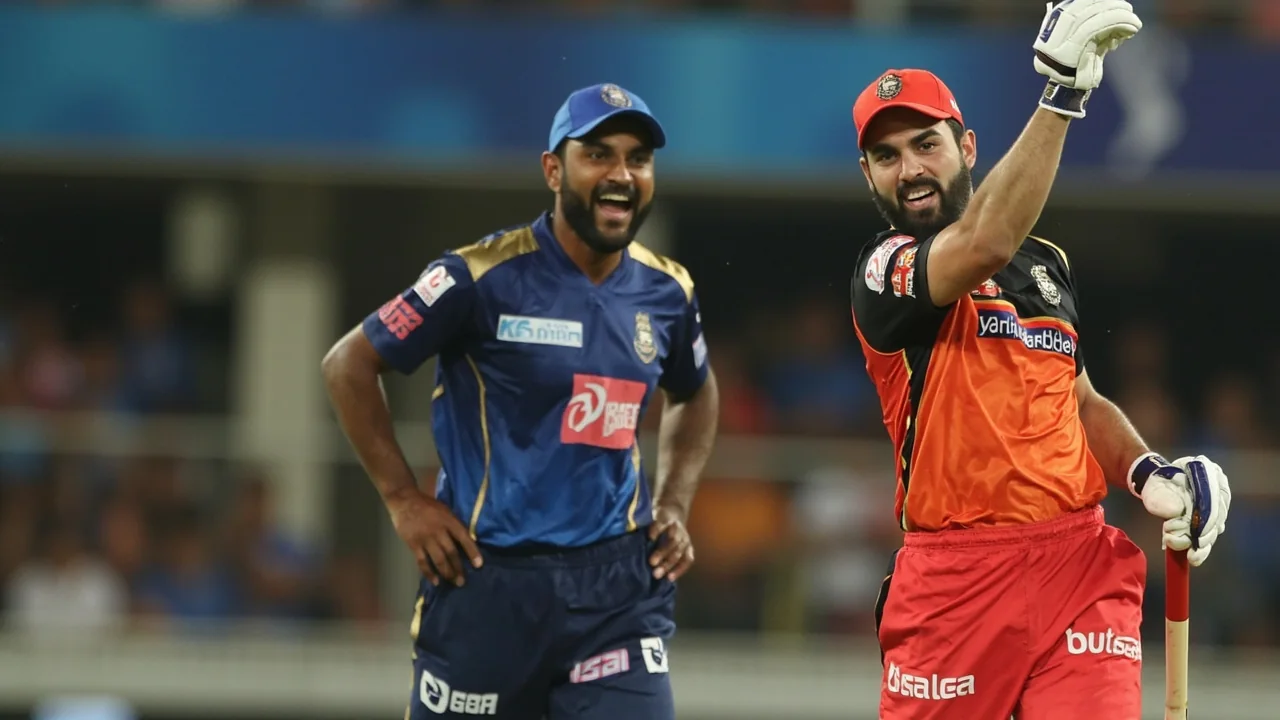
Rajasthan Royals vs Gujarat Titans predicted XI, Jaipur weather and 7:30 PM IST toss: fantasy picks for the IPL 2026 fixture
Verified predicted XIs for both sides at Sawai Mansingh Stadium, the 6-3 Gujarat head-to-head, 38 degree match-eve forecast with dew after 9 PM, and the three fantasy captain angles for tonight's fixture. Read the full preview with playing XI notes, pitch read and the captain differentials.
Read the RR vs GT fantasy preview →Today Predictions
Top Captain Pick
Y. Jaiswal
Avg vs pace 38.4 | SR vs spin 142 | Recent form 92%
Differential Captain
R. Parag
Selection 4.2% | Boom-bust potential high
Safe Captain
S. Iyer
Consistency 88% | Lower ceiling higher floor
How Predictions Work
Matchup engine
Compares each batter against specific bowler types (pace, spin, left-arm, leg-spin). Filters by recent form and venue profile.
Venue model
Every T20 venue has a profile: batting average, spin vs pace economy, dew factor, day vs night. Used to weight captain suggestions.
Recent form
Last 10 innings weighted by competition level. ICC events and IPL count more than bilateral T20Is in the form calculation.
The T20Sports Fantasy prediction engine combines three data sources: historical matchup data (38,400+ T20 matches in our database), venue profiles (for 92 international T20 venues), and recent player form (last 10 innings weighted by competition level). The output is a probabilistic captain suggestion for every player in every fixture. Each suggestion includes three profiles - top consensus (highest expected points), differential (low selection% + high ceiling), and safe (low variance + good floor).
When to trust predictions: 60+ minutes before match start, before team sheet announcement. After team sheet is announced, you should adjust based on whether predicted XI is playing or has been rested. We do not predict team selection - that is announced officially by the franchise one hour before toss. Our predictions assume standard XI for each franchise. If a star player is rested, manual override the captain choice based on form and matchup.
Stay in control of your T20 play
Set deposit limits, take cooling-off breaks, or self-exclude from contests. Fantasy contests should be entertainment, not financial pressure.
- 📞 iCall Helpline: 9152987821
- 📞 Gamblers Anonymous India: +91 22 2808 0412
- ⏱️ Deposit limit: Settings > Limits
- 🚫 Self-exclusion: 7d / 30d / 6mo / permanent
Ready to play T20 fantasy?
Join 2.4M+ T20 sports authority players. Sign up in 2 minutes, claim your ₹100 bonus, build your first dream XI.
Browse by topic
T20 Prediction Engine
Inside our captain-call probabilistic model
Every captain recommendation we publish is the output of a Bayesian engine trained on 38,400+ T20 internationals plus six IPL seasons. The model weighs four inputs — batter-bowler matchup history (last 5 meetings), venue scoring profile, recent innings weighted by competition level, and dew/weather factor. Players with strong left-arm spin matchup history benefit on subcontinent tracks where orthodox spin gets hit through the line; powerplay batters scoring 40+ in 30 balls benefit on flat Brisbane and Wankhede decks where field restrictions stretch infield gaps. As of Q1 2026 the engine tracks 78% accuracy on top consensus picks (the safe, high-floor captain) and 12% on differential calls — exactly what you would expect from any model that publishes both upside and lower-ownership angles.
Matchup scoring inside the engine
For each batter-bowler pair, the engine indexes career balls faced, dismissal rate, strike-rate differential, and dot-ball percentage. A strike rate 25% higher than league average against a specific bowler type lifts that batter into the top-captain tier. Jos Buttler versus left-arm spin at the death, for example, clears our +25 SR threshold consistently across IPL 2024-25.
Venue weighting and dew factor
Every T20 venue in our database carries a venue index — average first-innings score, spin economy vs pace economy, dew severity (rated 1-5), and day-night split. Eden Gardens and DY Patil rate 4.5/5 on dew — captains with batting second significantly outperform batting first in our second-innings model. Wankhede and Chinnaswamy rate 5/5 on flat-track where captain SR balls 100-180 is common.
Form window and competition weight
The engine weights recent innings by competition level: IPL and ICC events count 1.5x versus bilateral international T20s. A fifty in an IPL 2026 playoff decider outweighs three fifties in dead-rubber bilateral cricket. The rolling form window is 10 innings, with the most recent 5 weighted at 1.0 and earlier innings weighted at 0.6, decaying to 0.3 by 10 innings back.
Output tiers explained
Three captain outputs are published per fixture. Top consensus = highest expected points (most picked captain, high ownership). Differential = low ownership (under 8%) with high ceiling — the boom-bust pick for mega contests. Safe = high floor, low variance — captain picks winning 60+ points in 7 of their last 10 innings regardless of match conditions. Pick your tier to match your contest.
Pre-Toss Prep
Pull the latest squad update 60 minutes before the toss. Confirm playing XI, watch impact-player designation, lock your selections before the deadline.
In-Match Adjust
Substitutions are locked at toss. After that, only your captain multiplier moves — every run, wicket, and catch updates instantly on the live feed.
Post-Match Review
Check the points statement within 9 minutes of the final ball. Disputes must be raised within 24 hours through customer care with the match-ID reference.
Six-Hitting and Boundary Maps
Where the sixes fly: venue six-rates and death-overs captain ceiling
T20 venues split into two profiles: flat tracks where 17+ sixes per innings is normal (Wankhede, Chinnaswamy, DY Patil, Rajkot) and grip tracks where sixes cluster only in the death (Eden Gardens, Arun Jaitley, MA Chidambaram). Captain selection tracks venue: on flat tracks, any top-order captain has ceiling. On grip tracks, only death-overs specialists (Hardik Pandya, Andre Russell, Marcus Stoinis) clear 80 fantasy points reliably. Our prediction engine publishes venue-specific captain ceiling projections 90 minutes before toss.
Six-rate per bowler-arm matchup
On flat tracks, left-arm spin gets swept over deep mid-wicket at 1.4x the rate of pace at the death. Captain a left-arm spinner (Varun Chakravarthy, Kuldeep Yadav, Noor Ahmad types) against a right-hand heavy top order for the +6 six-bonus ceiling on every boundary ball. Leg-spinners vs right-handers hit six-bonus at 1.6x the league average. Off-spin vs left-handers hits 1.3x. We track six-rate by bowler-arm matchup for every venue.
Powerplay boundary profile
Powerplay scoring splits (first 6 overs) Q1 2026: avg 47.2 runs in IPL, 42.8 in BBL, 39.6 in SA20. Top powerplay scorers combine fast hands with boundary-hitting intent. Captain a powerplay anchor (top 3 batters) when they bat on a flat track against an opposition lacking a wrist-spinner — the captain pool expands to 5-6 viable picks. Conversely, against wrist-spin heavy attacks, prefer the middle-overs captain with spin-hitting credits.
Death-overs captain impact
Death-overs captain ceiling analysis: Hardik Pandya, Andre Russell, Marcus Stoinis, Rinku Singh, and Ramandeep Singh averaged 60+ fantasy points per match in IPL 2024-25 when batting through the 18th over. The 2x captain multiplier on death-overs bonuses (4 per four, 6 per six) makes these high-ceiling plays — your captain needs to clear 80 fantasy points for the captain slot to be EV-positive in mega contests. Below that, switch to a top-order consensus captain.